The Tenfold Tax: Systems Attrition in the Ukraine Energy War
BLUF: The Tenfold Tax
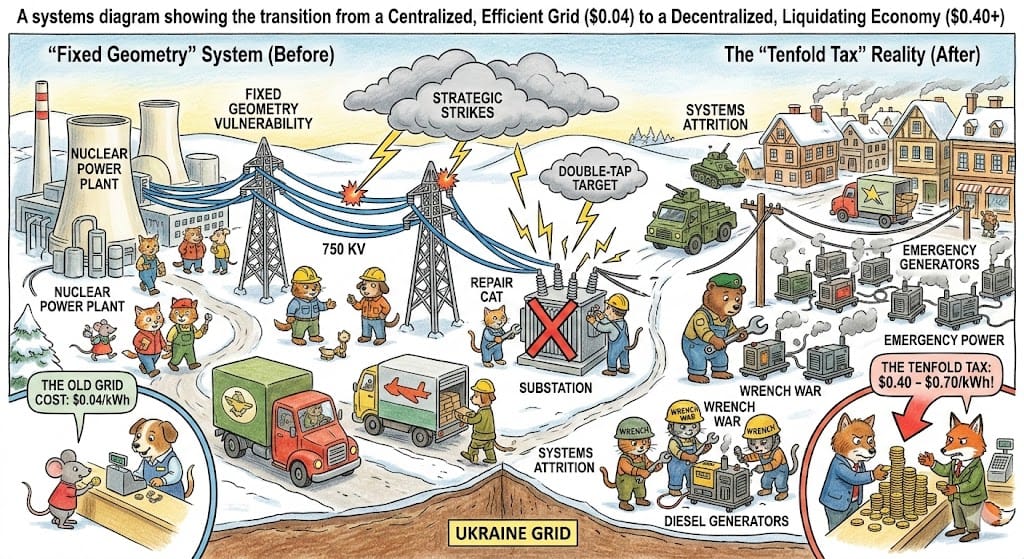
In modern warfare, you don’t need to destroy an army to paralyze a nation; you just have to make it too expensive to exist. Russia’s campaign against the Ukrainian grid has transitioned from kinetic destruction into a permanent "Economic Front." By forcing a shift from a $0.04/kWh grid to a $0.40/kWh generator reality, the adversary has imposed a Tenfold Tax on the population.
The Financial Math
Before February 2022, the Ukrainian household was paying roughly 4 cents per kilowatt-hour. Today, despite massive government subsidies, the official residential rate has climbed to nearly 11 cents.
But that is a subsidized fiction. The real market reality is visible in the industrial sector and among the millions of citizens forced off the grid. When the substations go down, the country switches to diesel. Once you factor in fuel, maintenance, and the logistics of a war-torn supply chain, the cost jumps to between 40 and 70 cents. That is a 1,000% increase in energy overhead.
The Anatomy of Destruction
This isn’t collateral damage; it’s a systems-hack. Russia is targeting the 750 KV backbone—the massive hubs that move power from nuclear plants to the cities. By hitting these high-voltage nodes, they exploit the "Fixed Geometry" of the grid.
Replacing a single high-voltage autotransformer isn’t a quick fix—it’s a 12-to-24-month lead time for equipment that costs millions and requires specialized heavy-lift logistics. Russia is effectively outpacing the global supply chain, ensuring the grid stays broken.
The War on the Wrenches
Perhaps most critical is the targeting of Institutional Memory. There is a deliberate war being waged against energy workers. We have documented "double-tap" strikes: an initial strike on a substation, followed by a second strike 30 minutes later timed to catch the repair crews. When you kill the engineer who knows the workarounds for a 40-year-old Soviet-era transformer, you aren't just destroying hardware—you are disabling the system’s ability to heal itself.
The Systems Takeaway
The lesson for every leader is this: Fixed assets are sitting ducks. In a world of cheap drones and long-range precision, if your energy security has a fixed physical address, it is a liability. Centralization is no longer an asset; it is a vulnerability. We are watching the death of 20th-century grid architecture under the weight of sheer economic attrition.
Ready to Slay the Dragon?
Don't let systemic bottlenecks dictate your strategy. Join our working group to master the frameworks that turn constraints into advantages.
Join the Working Group
Discussion