The Economic Pivot of Attrition
Stay Ahead of the Systems Collapse
Traditional grids are failing. Join our network to explore the future of mobile, resilient energy systems.
Join the NetworkDisclaimer: The views expressed are those of the author and do not reflect the official policy of the Department of the Navy or the DoD.
BLUF: The Economic Pivot of Attrition
The Ukrainian energy crisis has proven that in modern conflict, the cost of energy is not dictated by market fundamentals, but by the speed of infrastructure degradation. As an adversary systematically dismantles a terrestrial-fixed grid, the "True Cost" of power escalates precipitously, driven by emergency import premiums and the loss of sovereign generation. This creates a critical strategic inflection point: when the expense of defending and repairing fixed assets exceeds the cost of non-terrestrial or mobile alternatives, maintaining the status quo becomes a recipe for economic collapse.
Pillar I: The Economic Gravity of Infrastructure Attrition
The financial trajectory of the Ukrainian energy sector from 2021 to 2026 demonstrates how kinetic attacks force an exponential price surge that detaches from domestic reality.
• The Scarcity Premium: In early 2022, Ukrainian wholesale prices were roughly 3.35 times lower than European spot markets. By January 2026, the market was clearing at regulatory caps of 15,000 UAH/MWh (~$380/MWh) just to attract record-breaking imports of 894.5 GWh.
• The "True Cost" vs. The Shield: While residential rates remain a subsidized social shield at roughly $0.11/kWh, the unsubsidized industrial sector faces costs approaching $480/MWh when transmission and distribution tariffs are included.
• Macroeconomic Contraction: When industrial facilities cannot procure energy even at punitive prices, the resulting "Value of Lost Load" (VoLL) drives exponential GDP loss, ruined production, and idled labor.
Pillar II: The "Bespoke" Trap and the Maintenance Kill Chain
Fixing a terrestrial grid during an active conflict is a losing game because the adversary holds the initiative over the "maintenance kill chain".
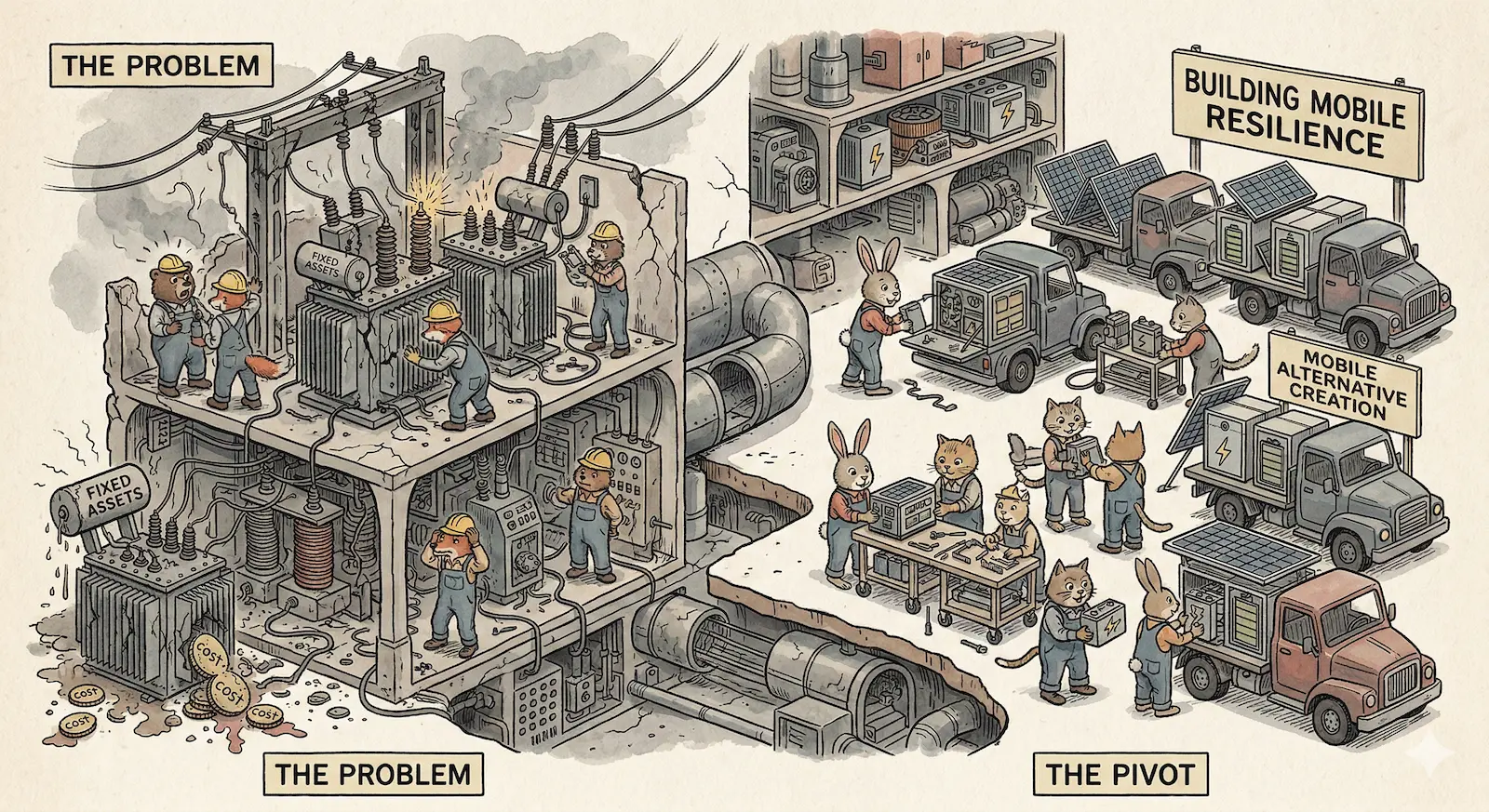
• Logistical Friction: Replacing a 750 kV transformer is not a routine task; it involves 200-ton bespoke equipment that is difficult to manufacture and transport under fire.
• Targeted Assassination: The cost includes the irreplaceable loss of human capital. In January 2026 alone, high-ranking officials like Ukrenergo Chairman Oleksii Brekht and frontline technicians were killed while performing emergency repairs at targeted sites.
• The Vulnerability of Scale: Large-scale centralized plants, once seen as efficient, have become "vulnerabilities of scale" where a single successful strike can eliminate gigawatts of capacity, such as the total destruction of the 1.8 GW Trypilska TPP in 2024.
Pillar III: The Strategic Mandate for Non-Terrestrial Redundancy
While terrestrial grids—enhanced by future technologies like fusion—will remain the backbone of peacetime economies, Ukraine serves as a "post-mortem" for relying solely on fixed infrastructure during war.
• The Geostatic Liability: Any infrastructure tied to a fixed coordinate is a "sitting duck" for 21st-century precision munitions.
• Economic Parity of Alternatives: The levelized cost of energy (LCOE) for distributed diesel generation in Ukraine has already reached $0.50/kWh. This high threshold makes advanced, non-terrestrial, or rapidly deployable mobile power solutions increasingly economical in high-threat environments.
• The Backup Doctrine: National security now requires a "Plan B" that decouples energy delivery from static geography. If a nation cannot move its energy source, it cannot protect its economy from systematic attrition.
Post-Mortem: If It’s Fixed, It’s Dead
The "True Cost" of energy in Ukraine is ultimately measured in human life and the irreversible degradation of sovereign capital. The lesson for global strategists is clear: a 20th-century terrestrial grid is a fragile anchor in a 21st-century conflict. To avoid the fate of Ukraine, future energy doctrines must prioritize mobility and non-terrestrial redundancy. When the grid becomes a target, survival depends on being where the adversary is not looking.
Ready to Slay the Dragon?
Don't let systemic bottlenecks dictate your strategy. Join our working group to master the frameworks that turn constraints into competitive advantages.
Join the Working Group
Discussion